Industrial Doors: Specified Correctly, Installed Right, Built to Last

Expert supply, installation and maintenance of industrial door systems for manufacturers, logistics operators and commercial landlords. DHF-accredited engineers, no subcontractors, South West coverage.

Why the Right Industrial Door Specification Matters More Than the Price

An industrial door is not a commodity purchase. The wrong specification for your building, your operational environment and your daily cycle count will cost you significantly more in repairs, downtime and early replacement than the saving made at the point of installation. A sectional door specified without a proper structural survey, a folding door fitted without adequate headroom clearance, or an automated system installed without the right safety devices are not just inconveniences. They create genuine operational and compliance risk.

Brunel Doors has been supplying and installing industrial door systems across Bristol and the South West since 2010. We work with manufacturers, logistics operators, food producers, cold storage facilities, local authorities and commercial landlords. Every project begins with a thorough site survey carried out by one of our own engineers, who will assess the structural environment, the daily cycle requirements, the loading conditions and any relevant planning or compliance constraints before a single product is recommended. That process is what allows us to specify with confidence, and it is why our installations perform reliably for the long term.

15+

Years trading

DHF

Accredited

IPAF

Certified

Site survey

on every job

Sectional, Folding or Sliding: Matching the Door to Your Building

Industrial door requirements vary enormously across different facility types, building ages and operational patterns. A high-bay distribution warehouse in Avonmouth has fundamentally different demands to an older manufacturing unit in Yate or a temperature-controlled food production facility in the Bath area. We work with a carefully selected range of industrial door systems from industry-leading manufacturers, and we specify on the basis of what is right for the building and the operation, not what is easiest or most profitable to install.
Industrial Doors

Sectional Overhead Doors

The most widely specified industrial door type for warehouses, distribution centres and manufacturing facilities with regular vehicle traffic. Sectional doors open vertically in horizontal panels that track back along the ceiling line, maximising usable floor space in front of the opening and maintaining clear headroom inside the building during operation. Available insulated or non-insulated depending on thermal requirements, with manual or fully automated operation to suit the daily cycle count of your facility. We supply and install systems to BS EN 13241, with options including wicket gates for pedestrian access, vision panels, perforated ventilation panels and a wide range of surface finishes. Insulated sectional doors are particularly effective in cold storage and food production environments where maintaining a consistent internal temperature directly affects operating costs.
Industrial Doors

Vertical Lift Sectional Door

The right solution for buildings where height is available above the opening but ceiling depth is insufficient for a standard overhead track. Rather than transitioning to a horizontal ceiling track, the panels travel straight up on vertical guide rails and come to rest above the opening, preserving crane clearance, ceiling-mounted plant and overhead services. Particularly well suited to high-bay warehouses and cold stores where maximising usable internal height is operationally important. We carry out a full structural assessment before specifying any vertical lift system.
Industrial Doors

Steel Personnel Doors

A heavy-duty industrial door installation is only as secure as the weakest access point in the building envelope. Steel-framed personnel doors specified alongside the industrial door system from the outset ensure a consistent level of protection across every entry point, rather than a robust vehicle access door flanked by an inadequate personnel entry. Available in single and double leaf configurations, with ironmongery options including panic hardware, mortice deadlocks and self-closing mechanisms where required by fire strategy or building regulations. We can match finish and colour to the adjacent industrial door system to maintain a consistent and professional appearance across the full building frontage.
Industrial Doors

Sliding Doors

The practical alternative for openings where vertical operation is impractical, most commonly on older buildings with restricted floor-to-ceiling clearance, wide agricultural openings or industrial units where the structural arrangement makes overhead tracking impossible. Available in single-leaf and bi-parting configurations, with manual or motorised operation depending on size and frequency of use. Track configuration, whether bottom-rolling or top-hung, is determined by the condition and load-bearing capacity of the floor and the structural frame above the opening. Getting this right at the survey stage prevents operational problems and premature track wear further down the line. Sliding doors are widely used across the agricultural, logistics and light manufacturing sectors throughout the South West.
Industrial Doors

Panoramic Sectional Door

Sectional doors with large toughened glass or polycarbonate vision panels set within a powder-coated aluminium or steel frame. They admit natural light, maintain sightlines through the opening when closed, and provide a far more refined frontage than a standard industrial door. Widely specified for vehicle showrooms, commercial workshops, fire stations and modern commercial buildings where the door forms part of the architectural frontage. Available with double-glazed insulated units and fully automated operation.

The Right Specification, Every Time

Industrial door projects go wrong most often at the specification stage, not the installation stage. A door that is undersized for the vehicle it needs to clear, under-specified for the cycle count of the facility, or installed without adequate safety devices creates problems that are expensive and disruptive to resolve after the fact. Our starting point on every industrial door project is a thorough site survey, conducted by one of our own engineers, not a salesperson. They will measure the opening, assess the structural environment, understand how the door will be used and by whom, and identify any constraints that affect the specification before anything is recommended.

Because we are independent, we are not committed to a particular manufacturer’s product range. We select from a carefully chosen group of suppliers whose systems we know well and trust, and we specify the product that is most appropriate for the job. Our engineers are DHF-accredited and hold IPAF certification, which is particularly relevant for large-format industrial door installations in high-bay environments where powered access equipment is required during fitting. This means the full installation is carried out by our own team without the cost and coordination complexity of bringing in a separate access contractor.
We work with facilities managers, operations directors, estates teams and commercial landlords across Bristol, Avonmouth, Severnside, Yate, Bath and the wider South West. The clients who stay with us long term do so because the doors we specify work properly, the engineers who fit them know what they are doing, and when something needs attention afterwards, we are straightforward to get hold of.
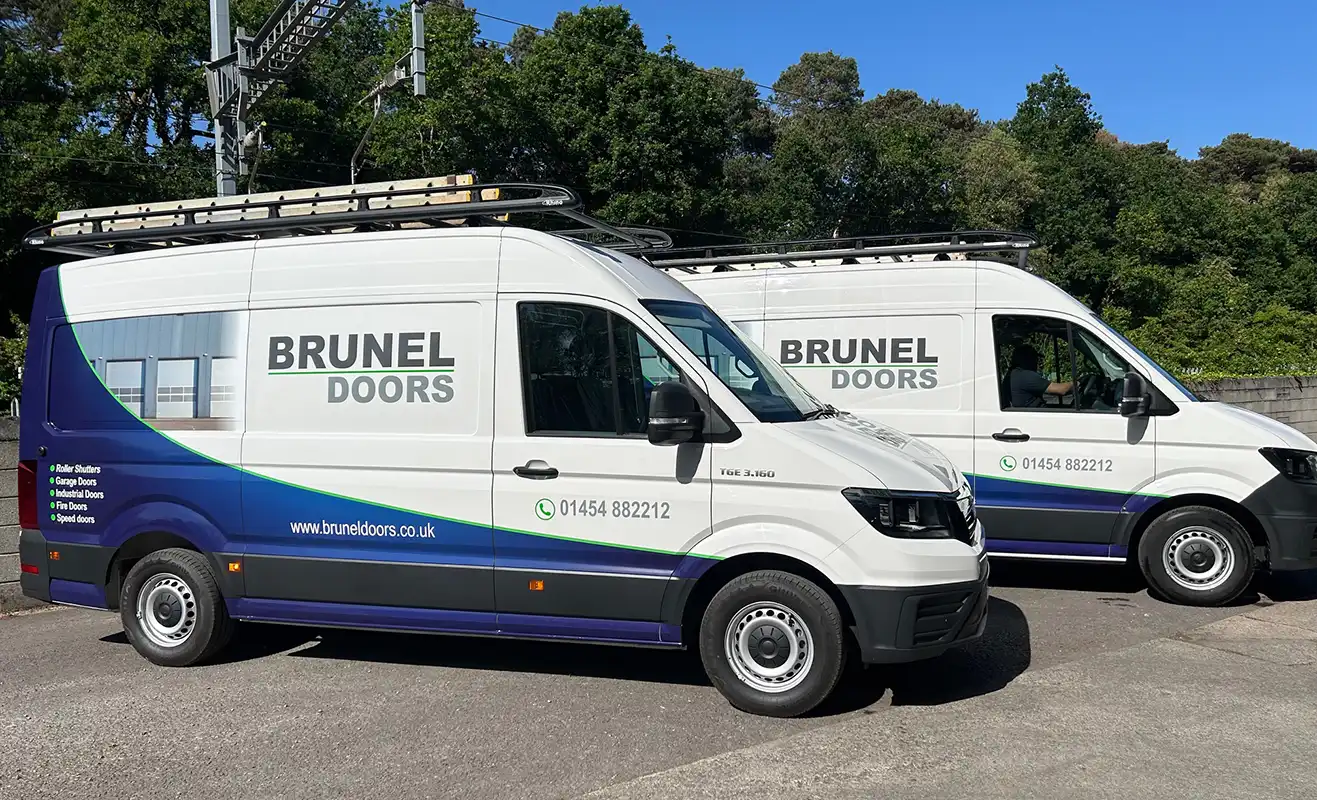
Brunel Doors Vans at the offices in Bristol

Industrial Door Maintenance & Emergency Callout Across Bristol
Industrial doors fail in predictable ways. Torsion and extension springs fatigue with cycle count, not with age, which means a door in a busy distribution environment may need spring replacement within three to four years while the same door on a low-use agricultural building could last fifteen. Track wear, bottom seal deterioration, limit switch drift on automated systems and motor brush wear are all gradual processes that a planned maintenance programme catches before they become failures. A Brunel Doors maintenance visit covers spring tension assessment, track and roller inspection, lubrication of all moving components, limit switch calibration on automated systems, bottom seal condition and a full operational test. Every visit is documented, providing the maintenance record your insurance and compliance obligations require under the Workplace (Health, Safety and Welfare) Regulations 1992.

When a door does fail unexpectedly, the operational impact in a warehouse or manufacturing environment is immediate. Our engineers are based across Bristol and South Gloucestershire, which means we can typically reach sites across the region faster than a national contractor dispatching from outside the area. We carry counterbalance springs in a range of wire gauges and coil diameters, motor components, limit switches, bottom seals and track hardware for the systems we install and maintain, and the majority of industrial door breakdowns are resolved in a single visit. For multi-site clients, we can structure a maintenance programme across all locations to spread the cost and ensure consistent standards throughout.

The Credentials That Matter for Industrial Door Installation

Industrial door installation is physically demanding, technically complex and carries real safety implications if it is not done correctly. The accreditations our engineers hold reflect the specific demands of this type of work. IPAF certification is essential for high-bay industrial environments where sectional and folding door installations require powered access equipment, and every Brunel Doors engineer working at height is fully certificated. CSCS cards confirm that our engineers are formally qualified to work on commercial and industrial construction sites, a requirement on most managed sites and an important assurance for facilities managers and principal contractors. Our DHF membership, through the Door and Hardware Federation, means we adhere to the industry’s highest standards for installation quality, product safety and ongoing professional development. For clients in regulated industries or those with formal contractor approval processes, our SafeContractor accreditation means we are already pre-qualified and ready to work. All products we specify carry UKCA certification, and where Made in Britain equipment is available and appropriate, we will always consider it.

Frequently Asked Questions

How much does an industrial door cost?
The cost of an industrial door installation depends on the type of system, the size of the opening, the insulation specification, whether automation is required, and the structural conditions of the building. A manually operated sectional door for a small industrial unit sits at a very different price point to a large automated insulated door for a distribution warehouse or a wide-span folding door for a vehicle workshop. We provide free site surveys and clear, itemised quotations with no obligation to proceed. Call us on 01454 882212 or use the contact form to arrange a visit anywhere across Bristol, Bath or the South West.
How long does an industrial door installation take?
A standard sectional overhead door installation is typically completed within one to two days. Larger systems, bi-folding doors on wide openings, automated installations with loop detection or multiple safety devices, or projects requiring structural modification may take two to three days. We provide a clear programme as part of every quotation so you can plan site access and minimise disruption to your operation.
How often should industrial doors be serviced?
The Workplace (Health, Safety and Welfare) Regulations 1992 require employers to ensure that powered doors and gates are maintained in an efficient state and in good repair. In practical terms, we recommend a minimum of one planned maintenance visit per year for doors in low to moderate use environments, and twice-yearly visits for high-cycle facilities such as distribution warehouses, food production sites and cold stores. High cycle count is the primary driver of wear on springs, tracks and automation components, and catching problems early through planned maintenance is significantly cheaper than emergency breakdown repair.
What is the difference between a sectional door and a folding door for industrial use?

A sectional door opens vertically, with horizontal panels tracking back along the ceiling line inside the building. It is the most space-efficient solution where adequate headroom exists above the opening and inside the building for the door to track back. A folding door opens by folding its panels to one or both sides of the opening, and is the correct choice where headroom above the opening is restricted, where the full clear width of the opening must remain unobstructed during use, or where the structural arrangement of the building makes an overhead track configuration impractical. The right choice depends on the specific structural conditions of your building, which is why we carry out a detailed site survey before making any recommendation.

Industrial Door Projects Completed Across Bristol, Bath & the South West

We supply and install industrial door systems across the South West, with considerable experience on the large commercial and industrial estates of Avonmouth and Severnside, where the concentration of distribution, logistics and manufacturing operations creates regular demand for high-specification sectional and automated door systems. We work regularly across Yate, Thornbury, Chipping Sodbury and Portishead in South Gloucestershire, and serve clients in Bristol city centre, Bedminster, Brislington and Southmead, as well as Bath, Keynsham and Weston-super-Mare. For businesses with multiple sites across the region, we can coordinate installation schedules and planned maintenance visits to ensure consistent standards and minimise operational disruption across all locations.

Bristol

Yate

Keynsham

Avonmouth

Thornbury

Weston-super-Mare

Bath

Portishead

Chipping Sodbury

You May Also Be Interested In

Roller Shutters

Roller Shutters

Made-to-measure steel and aluminium roller shutters for shopfronts, commercial units and warehouses across Bristol and the South West.
Loading Bay Doors

Loading Bay Doors

Sectional overhead doors, dock levellers and dock shelters for high-traffic warehouse and distribution operations.
High Speed Doors

High Speed Doors

Rapid roll doors for environments where speed, energy efficiency and high cycle frequency are all critical requirements.

Talk to an Engineer About Your Industrial Door Project

Contact us to arrange a site survey anywhere across Bristol, Bath or the South West. One of our engineers will assess your building, understand your operational requirements and provide a clear, itemised quotation with no hidden costs and no obligation to proceed.